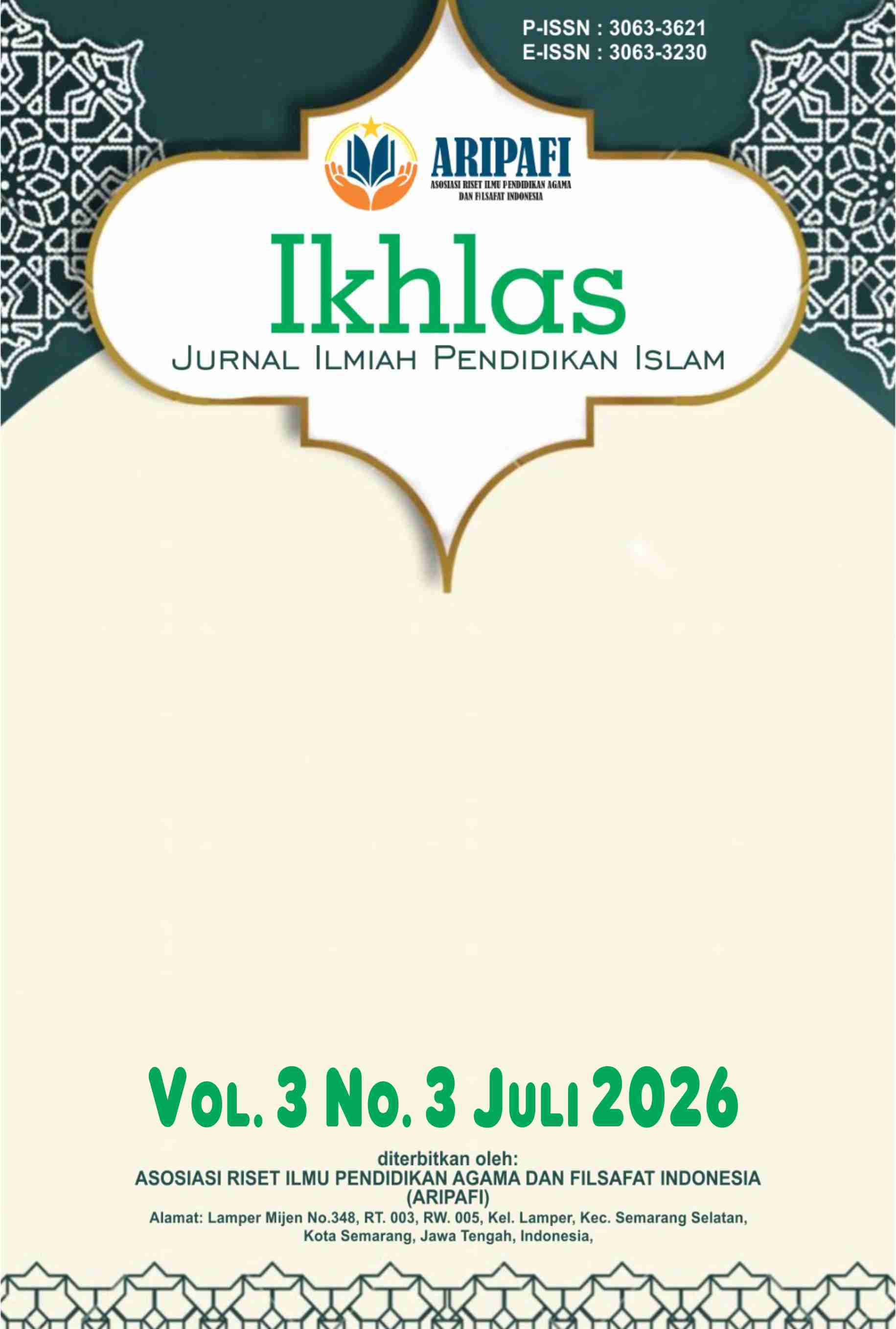
Kaidah Nāsikh dan Mansūkh pada Ayat Kebolehan Menikahi Ahl Al-Kitâb
Studi Komparatif dalam Tafsir Fii Zhilâl Al-Qur’ân dan Al-Azhar
DOI:
https://doi.org/10.61132/ikhlas.v3i3.2267Keywords:
Hamka, Naskh and Mansukh, People of the Book (Ahl al-Kitāb), Qur'anic Exegesis, Sayyid QutbAbstract
Allah Swt conveyed the Shari’ah through the Prophet Muhammad Saw with messages explicitly stated in the holy book, the Qur’ān. However, some of the Shari’ah rulings revealed by Allah Swt may appear to be textually contradictory, leading to legal issues in their implementation. One such case is the apparent contradiction between Surah Al-Baqarah (2:221) and Surah Al-Ma'idah (5:5). In this context, the author raises two main research focuses: how Sayyid Quthb and Hamka view the theory of Nāsikh and Mansūkh (abrogation in the Qur’ān), and how they interpret the permissibility of marrying women from Ahl Al-Kitâb (People of the Book). To answer these research questions, the researcher employs descriptive and interpretative methods. The first step is to describe Sayyid Quthb and Hamka’s interpretations of the two mentioned verses. The second step is to compare their interpretations regarding Nāsikh Mansūkh and the ruling on marrying women from Ahl Al-Kitâb. The study finds three key differences and similarities between the two scholars. Both Sayyid Quthb and Hamka affirm the concept of Nāsikh in the Qur’ān, but they differ in how they define the term Nāsikh itself. Both scholars prohibit marriage with polytheistic (Mushrik) women, but they differ in their views on marrying women from Ahl Al-Kitâb. Sayyid Quthb strictly prohibits marrying Ahl Al-Kitâb women, whereas Hamka allows it. Sayyid Quthb argues that Ahl Al-Kitâb no longer exist due to theological deviations among Christians and Jews. In contrast, Hamka maintains that Ahl Al-Kitâb still refers to Jews and Christians, without any time limitation.
References
Amal, T. A. (2005). Rekonstruksi sejarah al-Qur'an: Kritik terhadap ulum al-Qur'an. Pustaka Alvabet.
Armstrong, K. (2014). Sejarah Tuhan: Kisah 4.000 tahun pencarian Tuhan dalam agama-agama manusia. Mizan Pustaka.
AS, M. (2014). Studi ilmu Qur'an. PT Pustaka Litera Antar Nusa.
As-Shalih, S. (2016). Mabahits fi ulum al-Qur'an: Membahas ilmu-ilmu al-Qur'an. Pustaka Firdaus.
Hamka. (1982). Tafsir al-Azhar (Jilid III). Pustaka Panjimas.
Ibn al-Manzhur. (2003). Lisan al-Arab. Muassasah al-Risalah.
Izzan, A. (2009). Ulumul Quran: Telaah tekstual dan kontekstual al-Quran. Tafakur.
M., M. G. (2016). Ahl al-Kitâb: Makna dan cakupannya dalam Al-Qur'an. IRCiSoD.
Mufidah, M. D., & Nazla. (2017). Makna ahli kitab dalam Tafsir Al-Manar. Tafse: Journal of Qur'anic Studies, 2.
Penyusun, T. (2018). Pedoman penulisan skripsi Institut Dirosah Al-Islamiyah Al-Amien Prenduan. IDIA Press.
Al-Qattan, M. K. (2001). Studi ilmu-ilmu al-Quran (M. Mudzakir, Trans.). Pustaka Lentera.
Quthb, S. (2000). Fi zhilal al-Qur'an. Gema Insani Press.
Senja, E. Z., & Aprilia, R. (2008). Kamus lengkap bahasa Indonesia. Aneka Ilmu.
Shihab, M. Q. (2002). Tafsir Al-Misbah: Pesan, kesan dan keserasian Al-Qur'an (Jilid 3). Lentera Hati.
Shihab, M. Q. (2013). Wawasan al-Qur'an. PT Mizan Pustaka.
Suma, M. A. (2005, Januari). Naskh-mansukh dalam tinjauan historis dan syar'i. Jurnal Al-Insan, 1.
Thahhân, M. (1985). Taisîr mushthalah al-hadîts. Al-Hidayah.
Zahrah, M. A. (2008). Ushul fiqih (S. Ma'sum et al., Trans.). Pustaka Firdaus.
Zaid, M. (1951). An-naskh fi al-Quran al-Karim (Jilid I). Dar al-Fikr.
Zayadi. (2022). Penerapan teori nâsikh dan mansûkh Mahmoud Muhammed Taha pada ayat-ayat kebebasan beragama [Skripsi, Institut PTIQ]. Institut PTIQ. https://doi.org/10.59141/comserva.v3i06.1013
Mu'jam mufradat li alfazh al-Qur'an. (1972). Dar al-Fikr.
Downloads
Published
How to Cite
Issue
Section
License
Copyright (c) 2026 Abdul Muiz, Agung Saputra

This work is licensed under a Creative Commons Attribution-ShareAlike 4.0 International License.