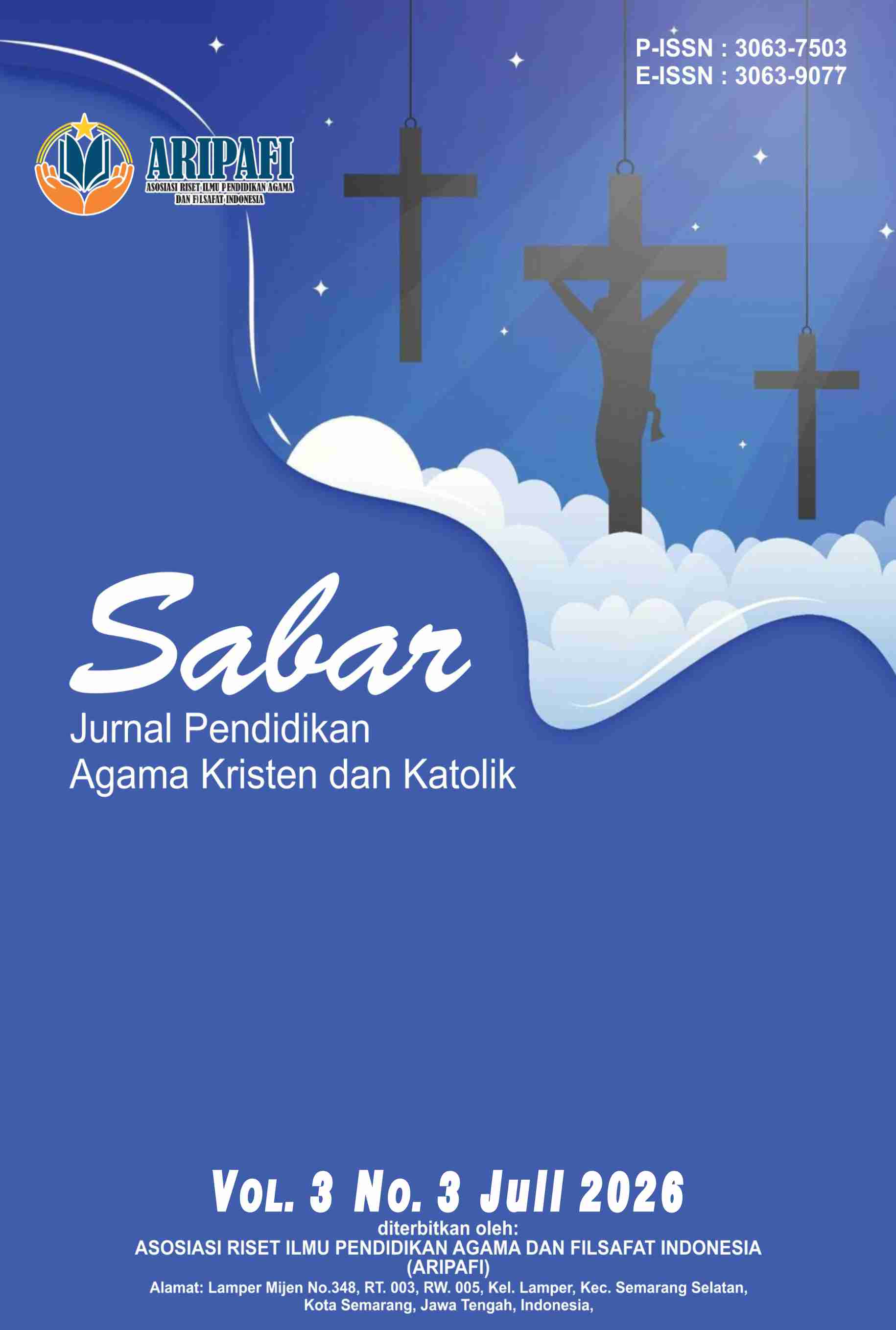
Efektifitas Model Pembelajaran Kooperatif dalam Meningkatkan Partisipasi Siswa Kelas VII Dalam Pembelajaran Agama Katolik di SMPK Swadaya Tuakepa
DOI:
https://doi.org/10.61132/sabar.v3i3.2370Keywords:
Cooperative Learning, Effectiveness, Learning, Catholic Religious Education, Student ParticipationAbstract
This study aims to determine the effectiveness of implementing the cooperative learning model in improving the participation of seventh-grade students in Catholic Religious Education and to identify the factors that support and hinder its implementation. This study employed a descriptive qualitative approach, which focuses on gaining an in-depth understanding of students' experiences, perspectives, and engagement in the learning process. Through this approach, the researcher sought to examine how the implementation of the cooperative learning model encourages students to participate more actively in Catholic Religious Education classes at SMPK Swadaya Tuakepa. Based on the results of interviews, observations, and documentation, the findings revealed that the implementation of the cooperative learning model significantly increased students' participation in the learning process. Students became more active in group discussions, asking and answering questions, expressing their opinions, collaborating with their peers, and participating in various classroom learning activities. The cooperative learning model also helped create a more engaging, interactive, and conducive learning environment, which enhanced students' learning motivation. However, several challenges were identified, including differences in students' abilities, a lack of self-confidence among some students, and limited instructional time. Nevertheless, overall, the cooperative learning model proved to be effective in improving the participation of seventh-grade students in Catholic Religious Education at SMPK Swadaya Tuakepa.
References
Agung Rozali, A., dkk. (2022). Kajian problematika teacher centered learning dalam pembelajaran siswa: Studi kasus SDN Dukuh, Sukabumi. Journal of Elementary Education, 5(1), 77–85. https://doi.org/10.22460/collase.v5i1.9996
Anggi Lena Widiastuti, A., dkk. (2025). Implementasi model pembelajaran cooperative learning tipe STAD dalam meningkatkan kerjasama dan keaktifan siswa SD. 6(12), 1824–1839.
Creswell, J. W. (2014). Research design: Qualitative, quantitative, and mixed methods approaches (4th ed.). Sage Publications.
Dasmita. (2017). Psikologi perkembangan peserta didik: Panduan bagi orang tua dan guru dalam memahami psikologi anak usia SD, SMP, dan SMA (7th ed.). PT Remaja Rosdakarya.
Emda, A. (2014). Penerapan model pembelajaran kooperatif tipe TPS di SMA Negeri 12 Banda Aceh. Lantanida Journal, 2(1). https://doi.org/10.22373/lj.v2i1.663
Johnson, D. W., & Johnson, R. T. (2018). Cooperative learning: The foundation for active learning. In IntechOpen. https://doi.org/10.5772/intechopen.81086
Konferensi Waligereja Indonesia. (2022). Pedoman katekese Gereja Katolik di Indonesia.
Lexy J. Moleong. (2018). Metodologi penelitian kualitatif. PT Remaja Rosdakarya.
Lie, A. (2012). Mempraktikkan cooperative learning di ruang-ruang kelas. Grasindo.
Nana Sudjana. (2019). Penilaian hasil proses belajar mengajar (22nd ed.). PT Remaja Rosdakarya.
Nur Elfawati, & Sapri, J. (2022). Penerapan model pembelajaran kooperatif tipe round table untuk meningkatkan partisipasi dan prestasi belajar siswa. Jurnal Pendidikan dan Pembelajaran, 12(1), 201–212. https://doi.org/10.33369/diadik.v12i1.21388
Nur Fadila, Z. (2020). Pengaruh pembelajaran contextual teaching and learning (CTL) terhadap pemahaman siswa pada mata pelajaran Pendidikan Agama Islam di SMP Negeri 1 Baturraden. Studi Islam, 1(2), 134–139. https://doi.org/10.30595/ajsi.v1i2.10132
Patton, M. Q. (2015). Qualitative research & evaluation methods: Integrating theory and practice (4th ed.). Sage Publications.
Rejeki Tulus, R., Sumarno, & J. S. (2023). Pengembangan perangkat pembelajaran model kooperatif tipe think pair share (TPS) dengan pendekatan konstruktivisme untuk peningkatan kemampuan berpikir kritis siswa kelas V SDN Tenggulangharjo. Didaktik: Jurnal Ilmiah PGSD FKIP Universitas Mandiri, 9, 1700–1714. https://doi.org/10.36989/didaktik.v9i2.862
Sigalingging, R. H., Harefa, S., & Naibaho, D. (2023). Role of the discussion method in increasing student learning motivation in Christian education subjects. 1(2), 117–133. https://doi.org/10.59653/jimat.v1i02.271
Slavin, R. E. (2015). Cooperative learning in elementary schools. International Journal of Primary, Elementary and Early Years Education, 43, 5–14. https://doi.org/10.1080/03004279.2015.963370
Sugiyono. (2023). Metode penelitian kualitatif. Alfabeta.
Thifal, R. F., Sujadi, A. A., & Arigiyati, T. A. (2020). Efektivitas model pembelajaran jigsaw terhadap hasil belajar matematika siswa SMK. Union: Jurnal Pendidikan Matematika, 8(2), 175–184. https://doi.org/10.30738/union.v8i2.8062
Trianto. (2014). Mendesain model pembelajaran inovatif, progresif, dan kontekstual: Konsep, landasan, dan implementasinya pada Kurikulum 2013. Kencana.
Ummil Khairiyah, H. R. D. (2022). Peran pendidikan karakter dalam mempersiapkan sumber daya manusia yang bermutu. 15(3), 119–124. https://doi.org/10.35134/jpsy165.v15i3.175
Downloads
Published
How to Cite
Issue
Section
License
Copyright (c) 2026 Theresia Paulina Nogo L. Makin, Yoseph Lodowik D. Dau, Emilia Dolorosa Taek

This work is licensed under a Creative Commons Attribution-ShareAlike 4.0 International License.